15 Mar 2019
Interview with Reto Weber
With Curiosity, Any Age Is a Good Age
Reto Weber recently turned 65 and has been performing for 45 years. The Biel percussionist is celebrating this double anniversary with two concerts. He still enjoys drawing inspiration from other cultures and feels at home even in exotic places. But not every encounter over the years has been harmonious.
Interview: Tobias Graden
Reto Weber, you are celebrating your 45th anniversary on stage and your 65th birthday. Strictly speaking, you are now retired.
Yes. So I won’t do anything anymore (laughs).
Your birthday marks a milestone for you; otherwise, you wouldn’t celebrate it.
That is down to my namesake Eberhard Weber. He organized a big concert at Theaterhaus Stuttgart for his 65th birthday, and I played in it. He said that you keep developing musically and should celebrate that every five years until you drop. Two years later, he had a stroke and could no longer play.
How have you developed over the past five years?
I have played a lot in the United States, with Chico Freeman and his uncle George Freeman. George is 92 and still a fantastic guitarist. I was one of the few Europeans who were able to perform at Jazz Showcase in Chicago. My stays in America have made my playing more “laid-back,” with that relaxed approach African American musicians have mastered.
At 65, which is stronger: nostalgia when looking back or excitement about what is still to come?
Excitement, absolutely. I am still as curious as I was 45 years ago. Whenever I am in a different culture—in Africa or Asia, for example—I always go to the market first. I immerse myself in the life of the market; after two hours, I have settled into local life and feel at home.
Are there places where you feel uncomfortable?
That was particularly true when we traveled to what was then the Eastern Bloc. We drove to East Germany in a VW van and had to wait five hours at the border. Everything was taken apart, and a border guard with a rifle stood beside us the whole time. East Germany smelled of coal, the lights were dimmed—it really was another world. I felt as though I had a rope around my neck. If we left our VW van outside the hotel overnight, all the stickers, such as the CH sign, would have been neatly removed by the next day—for people in East Germany, they were trophies.
Is 65 a good age for a percussionist?
If you are curious, as I am, any age is a good age. The most important thing is to stay healthy. There is still so much to discover; one lifetime is not enough to play everything I would like to.
Percussion is a very physical way of making music, so age imposes limits.
I was at physiotherapy again just today. My fellow musician Chico Freeman also has treatment there, and the whole team is coming to my concert tomorrow. Some time ago, I noticed that the right side of my body was no longer mobile. It has stiffened up—that is wear and tear from the millions of strokes I have played with some force throughout my life. That does not leave the body unmarked.
Does this affect you artistically? Do you play more gently?
No. I am still fully in the game. Improvisation is crucial in our music, and with good colleagues it is twice the pleasure. Something new can always happen.
You once said, “I am always looking for the melody.” Why are you a percussionist if melody is what matters to you?
It has to do with our cultural background, which is rooted in classical music. I, too, first received a classical training. Today, my philosophy is: first it has to groove, then I can think about the melody. Playing with trombonist Albert Mangelsdorff for many years was important to my understanding: he always sought the melody in his solos, but his simultaneous playing also provided groove. Just as Joe Zawinul did.
You have played with countless musicians around the world. Which encounter left the deepest impression?
Definitely the one with Albert Mangelsdorff. He became my musical mentor after I stepped in for a workshop’s tutors’ concert because the drummer who was supposed to play could not read music. We traveled together for 30 years, and I learned a great deal from him. He was a wonderful person; I never saw him angry. Once, the day after a concert, we were driving on to our next destination. After half an hour, he said, “Guys, yesterday’s concert was great.” I asked why he was saying that now, and he replied, “We played together for a whole minute.” (laughs) That was the free-jazz period for you.
Are you afraid that there might come a time when your curiosity runs out?
(thinks) I am not afraid. But there is a danger of slipping into a comfortable harmony in old age, of letting yourself drift along at your own leisurely pace. I do not want that. I am known for fast rhythms; when I can no longer play them, I will stop.
As a musician, you always belong to a particular generation. Is it important to you to keep your finger on the pulse of the times?
Very much so. For example, with Nino G. in Squeezeband, I was the first in Europe to put a beatboxer into a jazz context. A few months after our first rehearsal, he took me to a hip-hop festival where he was performing. People were throwing beer onto the stage, shouting over everything, and smoking cannabis. I watched and asked Nino what was going on. He said it was normal. I was amazed—nobody had ever thrown a beer can onto my stage.
What keeps you connected to the present today?
I need to give a little background. Thanks to the jazz schools, we have superbly trained musicians in Switzerland, but until a few years ago, only a few also had an identity of their own.
Are we about to hear a tirade against jazz schools?
No. A generation of young musicians is emerging today, especially from France, who play fantastically and have their own identities. I hope Switzerland gets swept along. In Biel, I see people like guitarist Roman Nowka, who was already doing things quite differently from everyone else at 20.
Is there something specifically characteristic of Biel in your playing?
Yes. We are a watchmaking city, and you can tell. When we need to, we play precisely, like clockwork. Fellow musicians from abroad appreciate that. Enrico Rava, the Italian trumpeter, once told me, “Only a Swiss musician could play the way you do.”
You have traveled all over the world. Did you never consider moving away?
I like having my social circle around me. Here, I can simply be and recharge. That is only possible in a city that is not too big and is also as beautiful as Biel. When I invite fellow musicians to Biel, they always say it is like being on holiday here.
If someone is less aware of your work in Biel, is that their own fault?
People do know me. But unlike others, I do not play in Biel ten times a year. People do not really want to see me more than once a year, and I think that is enough, too.
You rehearse in the Zwinglikirche. Why?
Because of the atmosphere. I have a church all to myself, the sound is wonderful, and I can meditate on my own.
So there is a spiritual element as well?
Yes. Practicing in a church for 25 years does leave its mark. I often start early in the morning, when nobody is here; it is like a morning prayer or a ritual. It is very inspiring, but that does not mean I feel a connection to the Holy Spirit because of it. It is about space, sound, and acoustics.
You also keep your instruments in the same building.
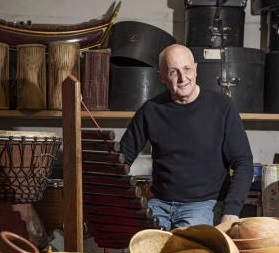
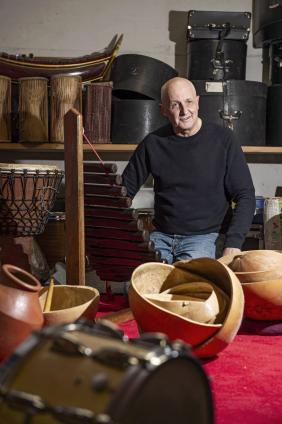
Yes, this is my transit depot. I store the instruments I play from time to time here. There are more than 100. But that is only half my collection (he picks up a wooden object).
What is that?
It is the Käserphon. Hermann Käser made it for me with wood from Büren (taps it). A fantastic tone. This instrument exists only for me; it is one of a kind.
What is your oldest instrument here?
My drum kit. It dates from 1969. Handmade, mahogany, by the Capelle brothers in Paris. They gave it to me in 1972, and it is still my drum kit today.
Why did they give it to you?
That was when I began giving solo concerts. I had a drum kit with plastic parts, and the sound was not good. Jacques Capelle saw me at a concert in Basel, came over, and told me I should visit him sometime: he made drum kits, but ones that were better than mine. I went. They made everything by hand and used calfskin heads—the heads alone for a drum kit like that cost about 5,000 francs (strokes them). They have a completely different sound; combined with mahogany, they produce a beautiful tone. So he gave me the drum kit; he wanted to support a young drummer. Once I became well known, I never switched to the big brands, even though there were offers and I would have been paid.
You have many exotic instruments. Which is the most unusual?
These, for example (points to small, packed drums). I got them from an instrument maker in Suphan Buri, in central Thailand. They are hand drums, and you tune them with dough.
With dough?
Yes, it is like the Indian Mridgangam. You can only play it if you dissolve rice powder in water, knead it into dough, and stick it to the heads. That lets you tune them precisely. For the South Indian Ghatam, you need clay for that.
How did local musicians react when a Swiss musician came along and adopted their instruments?
There is a story about that. I was in Madras with my Percussion Orchestra at the time, giving a concert in a hotel hall. Sitting in the front row, right in front of my Ghatams, was Thetakudi Harihara Vinayakram, the best Ghatam player of all, the man who made the Ghatam famous. I was playing four Ghatams at once. After the concert, he came up and said, “Hello, very interesting, you play my instrument!” I said I knew that and that it was an honor to meet him. He asked why I played four Ghatams at once, when in India they used only one. And what technique was I using? I said that was simply how I did it and that I had my own technique. He then invited me to his home the next day. We played all afternoon and ate together; it was extremely interesting. Later, I saw that he also had several Ghatams on stage.
That is a lovely story. But were there sometimes negative reactions as well?
The first reaction came in Biel in 1973. I played at the Théâtre de Poche with Nana Twum Nketia, a Ghanaian drummer. At the end, several people came up to me and said, “That was lovely, Reto, but why are you playing with a Negro?” I said it did not matter whether he looked green, blue, or red; we were simply playing together and enjoying ourselves. At the time, mixing cultures was extremely unusual; world music only emerged later.
World music was also viewed critically. Some voices said that musicians from the North were now exploiting the South culturally and making money from its culture.
I did not seek out this world-music story; I found myself drawn into it. We founded the Swiss Drums Orchestra in 1973. Nana and Papa Oyeah Makenzie were the exotic figures among the Swiss musicians. For our first performance, we wanted to begin with each person coming onto the stage in turn, playing for half a minute, and introducing himself that way. It went well until Papa Oyeah’s turn—he simply would not stop. Alex Bally, who was supposed to be next, got upset backstage: “Why is he playing for so long? It’s my turn now! He just won’t stop!” He went on stage and began playing over Papa Oyeah. The hall was full. Papa said, “That is Papa’s music! Now Papa is playing!” Alex stood up, threw down his sticks, and shouted, “Now it’s my turn! You have to stop!” And the two went for each other. The organizer asked me whether that was part of the plan.
How did it end?
It was this group’s first and last concert.
And then?
I continued playing with Nana and Papa Oyeah Makenzie, and other musicians joined us later. That is how we established a culture of exchange among percussionists in Europe. We always did so with the greatest respect for the other culture and its representatives. With the emergence of world music came this bad habit of superficially mixing things together. But you really have to immerse yourself in another culture if you want to understand it. For example, I only ever carried Djamchid Chemirani’s Iranian zarb around; I never played it. I simply cannot master the technique it requires. Something similar applies to the Indian tabla: anyone who is not from India can never play it the way an Indian does. But we can incorporate such instruments into our music in our own way.
Are you still adding new instruments, or is your collection complete?
I have finished collecting. In recent years, flying has become incredibly difficult. In the past, I could tell Swissair that we were traveling with instruments for cultural exchange, and staff would arrive with trolleys and take our luggage. These days, we struggle just to take our own instruments. Svante Henryson, who is playing cello with us tomorrow, always needs two plane tickets—one for himself and one for the cello. That is why I stopped collecting; taking the luggage has become too expensive. I am now making an inventory, and museums have already expressed interest.
If you give instruments away, you lose some of the variety of your expression.
At least in my public programs, I am reducing things to the Hang, the Ghatam, and various hand drums. I feel comfortable with that at the moment. Ultimately, everything is transient anyway.
Info: Concert tomorrow, November 18, with Chico Freeman (saxophone) and Svante Henryson (cello); next Sunday, November 25, with Nino G. (beatbox), Chico Freeman (saxophone), Christy Doran (guitar), Heiri Känzig (bass), and Rodrigo Rodriguez (percussion). Both at 5 p.m., Stadtkirche Biel.
About Reto Weber
- Born in 1953 in Solothurn
- Began playing drums in a school band at 14
- Studied contemporary percussion in Basel
- Began giving solo concerts on a large drum kit in 1973
- Developed into a multi-percussionist, taking him to many countries in Europe, Asia, Africa, and North and South America
- Concerts in more than 100 countries; participation in more than 45 recordings
- Collaborations with countless musicians, including Dave Holland, Albert Mangelsdorff, Eberhard Weber, Chico Freeman, Hans Koch, Bruno Spoerri, Christy Doran, Eberhard Weber, Harald Haerter, Franco Ambrosetti, Rainer Brüninghaus, and many more